
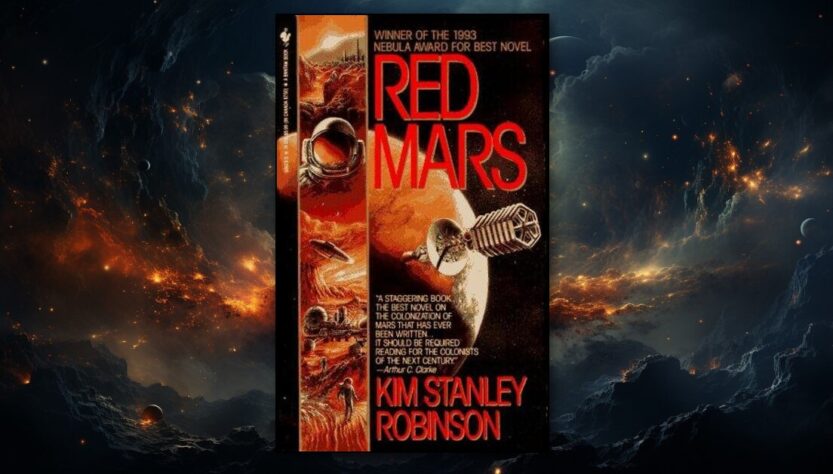
There’s a particular kind of science fiction that doesn’t just want to tell you a story. It wants to teach you orbital mechanics, areology, and the finer points of Martian regolith composition while it’s at it. Red Mars is that book, turned up to eleven.
Kim Stanley Robinson’s 1992 epic follows the First Hundred, a hand-picked group of scientists and engineers sent to colonise Mars. And when I say “follows,” I mean Robinson straps you into the passenger seat and makes you feel every single kilometre of that journey. The premise is genuinely brilliant. You’ve got a confined group of the world’s brightest minds, thrown together on a planet that wants to kill them, and they immediately start disagreeing about whether they should terraform Mars or leave it pristine. It’s a pressure cooker of ideology, ego, and survival, and when those tensions boil over, it’s fantastic.
The problem is getting to those boiling points.
Robinson is, without question, a deeply knowledgeable writer. His understanding of planetary science, engineering, and the practicalities of building a civilisation from scratch is staggering. When he describes the construction of Underhill, the early settlement, or the mechanics of the space elevator, you genuinely believe this is how it would work. The man did his homework, and then he did everyone else’s homework too.
But here’s the thing. There are passages in Red Mars where you could swear Robinson is writing a geological survey rather than a novel. Pages and pages of Martian landscape description, lovingly detailed, scientifically rigorous, and occasionally soul-crushingly slow. I lost count of the number of times I found myself drifting during yet another extended meditation on the colour of canyon walls at sunset. It’s beautiful writing in isolation. In context, it can feel like wading through treacle to reach the next plot beat.
And those plot beats, when they arrive, genuinely land. The political manoeuvring between characters like Frank Chalmers and John Boone is gripping stuff. Frank is one of the most fascinatingly awful characters I’ve read in sci-fi; a man so consumed by jealousy and ambition that he’ll reshape the future of an entire planet to settle a personal score. The rivalry between the “Reds” who want Mars left wild and the “Greens” pushing for terraforming feels prescient and real. Robinson understands that humans don’t stop being petty, political animals just because they’ve moved to another planet.
The rotating POV structure works well enough, though some perspectives are more engaging than others. Nadia’s practical, engineering-focused chapters were a highlight for me. She just wants to build things and solve problems while everyone else is busy having philosophical crises. Arkady’s revolutionary fervour brings genuine energy whenever he appears. Others, I’ll be honest, felt like assignments I had to get through.
If you enjoyed the hard science backbone of Arthur C. Clarke but wished he’d thrown in more political intrigue, there’s something here for you. Fans of The Expanse will recognise DNA in this book; Robinson was exploring the politics of space colonisation decades before Holden and crew. And if you loved Andy Weir’s The Martian but wanted something with broader scope and deeper themes, Red Mars delivers that. Just be prepared to work for it.
I came away from this one respecting it enormously while also feeling like I’d run a marathon. It’s the kind of book where you can see the masterpiece inside, but it’s buried under about 200 pages of geological description that could have been trimmed without losing anything essential. Robinson built something genuinely impressive here. I just wish he’d trusted his readers enough to paint with slightly broader brushstrokes.
Will I continue with the trilogy? Honestly, I’m not sure yet. The foundation is there for something special, and I’ve heard Green Mars picks up the pace. But I’ll need a palate cleanser first.
Audiobook Note
Richard Ferrone narrates the audiobook edition, and his steady, measured delivery suits the tone of the book well. Fair warning though; at nearly 24 hours, this is a serious commitment on audio. Ferrone handles the large cast capably, but during those longer descriptive passages, you’ll want to make sure you’re doing something active. Listening on a long drive or while painting minis is ideal. Lying on the sofa after dinner is a recipe for an accidental nap.
Rating: 3/5

The Audible UK edition is narrated by Richard Ferrone and runs to 23 hours and 51 minutes.
Discover more from Unfolded Universe: Sci-Fi Book Reviews
Subscribe to get the latest posts sent to your email.