
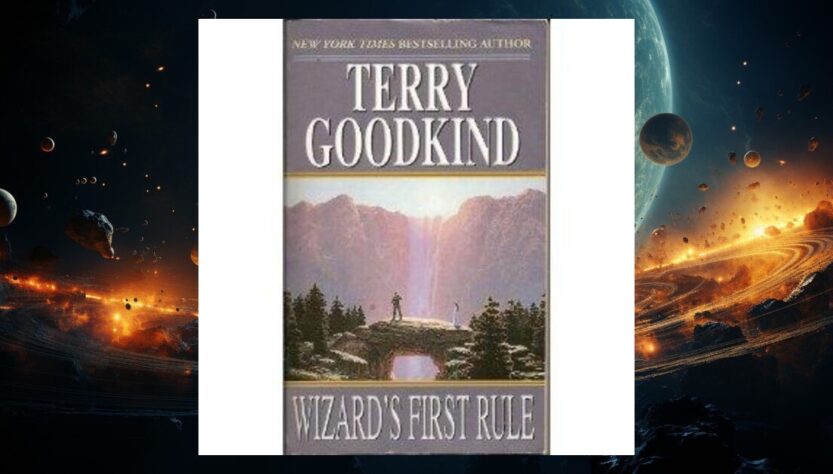
I’ll be honest with you. There was a point, somewhere around the halfway mark of this book, where I genuinely considered giving up. I’ve read War and Peace, and I say this without a shred of irony; Tolstoy was an easier read. That’s not a sentence I ever expected to write about an epic fantasy novel, but here we are.
Wizard’s First Rule is the opening volume of the Sword of Truth series, and it follows Richard Cypher, a woods guide in Westland who stumbles into a world-shaking quest after meeting a mysterious woman fleeing through the forest. That woman turns out to be Kahlan Amnell, a Confessor from the Midlands, and her arrival sets in motion a classic fantasy adventure involving ancient prophecies, a tyrannical villain, and a magical boundary between lands that’s starting to fail. Richard is joined by his old friend Zedd, a deceptively eccentric old man who turns out to be rather more than he appears, and together the three of them set off to prevent a rather nasty fellow named Darken Rahl from getting his hands on some very dangerous magical artefacts.
If that sounds like familiar territory, it should. Fans of David Eddings, Robert Jordan, or early Terry Brooks will recognise the bones immediately. The Chosen One, the wise mentor, the powerful and enigmatic love interest. Goodkind isn’t reinventing the wheel here, and that’s fine. The world-building has some genuinely interesting ideas. The Confessors and their terrifying power, the ability to destroy a person’s free will with a single touch, is a brilliant concept that adds real tension to the relationship between Richard and Kahlan. You want them to get together, but the consequences of that happening are horrifying. It’s one of the cleverer romantic obstacles I’ve encountered in fantasy.
The Pacing Problem
The issue, and it’s a significant one, is that Goodkind takes an extraordinarily long time to get anywhere. The first half of the book moves at the pace of a particularly relaxed glacier. There are stretches where very little happens, scenes that could have been tightened considerably, and a general sense that the story is meandering rather than building. I found myself checking how much was left more than once, which is never a good sign. For a book that’s essentially telling a straightforward quest narrative, it shouldn’t feel this laborious.
Then something strange happens in the final quarter. Everything accelerates dramatically. Plot threads that had been inching along suddenly sprint towards resolution, and the pacing swings from glacial to breathless almost overnight. It’s a jarring shift, and while I was grateful things were finally moving, it felt unbalanced. The climax could have used some of the space that the middle sections were hoarding.
The Dark Section
I need to address something that nearly made me put the book down for good. There is an extended section in the latter portion of the book, involving Richard’s captivity, that goes to some very dark places. I won’t spoil the details, but it involves the Mord-Sith, and it felt less like storytelling and more like endurance testing. The suffering inflicted on the protagonist seemed designed not to advance the plot but to make the reader squirm. It was gratuitously unpleasant in a way that felt needless, as if Goodkind wanted you to feel every moment of pain right alongside Richard. Some readers might see this as immersive. I found it excessive and, frankly, a bit manipulative. It cast a shadow over sections of the book that were otherwise quite compelling.
The Good Stuff
It’s not all criticism. When Goodkind gets it right, there’s genuine quality here. Zedd is a wonderful character, funny and warm and hiding depths beneath his eccentric exterior. The magic system has some thoughtful rules. The central concept of the Wizard’s First Rule itself, that people will believe a lie because they want it to be true, or because they’re afraid it might be, is genuinely clever. It’s the kind of idea that rattles around in your head long after you’ve finished, because you recognise it everywhere once you’ve seen it named.
The final stretch, despite being rushed, delivers some satisfying payoffs. Goodkind can write action when he puts his mind to it, and there are moments of genuine emotional weight in how the central relationship resolves. I came away from the last hundred pages thinking considerably better of the book than I had at the midpoint.
So Should You Read It?
That depends entirely on your tolerance for slow burns. If you’ve powered through the early Wheel of Time books without complaint, you may find Wizard’s First Rule perfectly manageable. If you bounced off the pacing in Jordan’s series, Goodkind will test you harder still. The ideas are here; the execution is uneven.
As for me, I’m genuinely unsure whether I’ll continue with the series. The ending earns enough goodwill to make book two tempting, but the thought of slogging through another 800 pages of similar pacing issues gives me pause. There’s a better book buried somewhere inside Wizard’s First Rule, and there are enough flashes of it to suggest Goodkind is capable of delivering one. Whether he does in the sequels, I honestly couldn’t tell you.
Worth reading if you’re a completionist of classic 90s epic fantasy. Approach with patience and realistic expectations.
Rating: 3/5
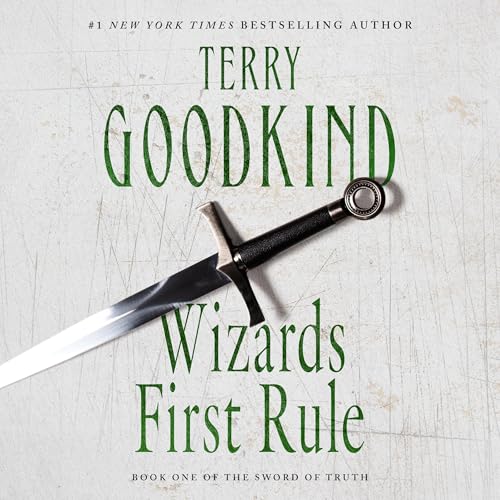
The Audible UK edition is narrated by Sam Tsoutsouvas and runs to 34 hours and 6 minutes.
Discover more from Unfolded Universe: Sci-Fi Book Reviews
Subscribe to get the latest posts sent to your email.