
The End of a Long Journey
There’s something satisfying about finishing what you started. I picked up the first volume of Clarke’s Collected Stories back in 2021, and three years later I’ve finally turned the last page of Volume 4. Four books, four stars each. Consistent? Absolutely. But that consistency says more about Clarke than it does about me. Across decades of short fiction, the man maintained a remarkably steady quality, and this final collection, covering his work from 1956 to 1961, catches him at arguably his sharpest.
Clarke at His Peak
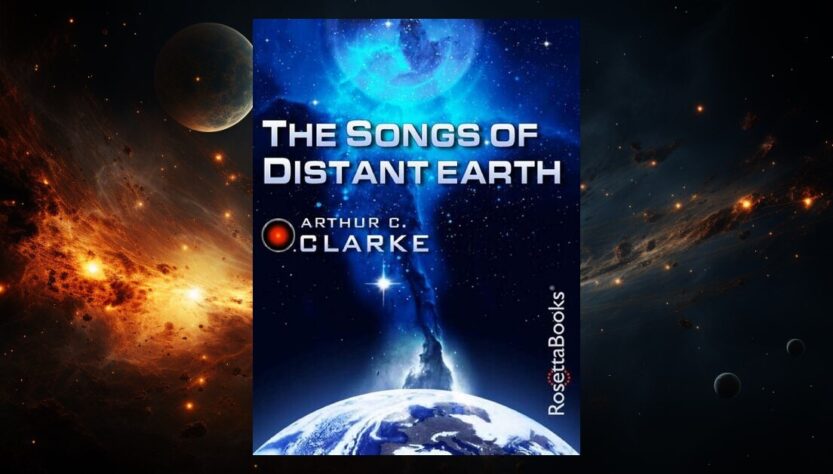
By this point in his career, Clarke had found his groove. The stories here feel more confident than those in the earlier volumes. There’s less of the slightly clunky early work and more of the polished, idea-driven fiction that made him a giant of the genre. The title story, “The Songs of Distant Earth”, is a beautiful piece of melancholy science fiction about a colony world that has long since lost contact with its origins. It’s spare and haunting in a way that the later expanded novel never quite recaptured. Sometimes the short story version is simply better, and this is one of those cases.
“I Remember Babylon” stands out for entirely different reasons. It’s Clarke in prophet mode, imagining satellite television being weaponised for propaganda and cultural disruption. Written in 1960, it reads like something ripped from a modern think piece about information warfare. Clarke had a genuinely unsettling knack for seeing where technology would take us, not just the hardware but the human consequences.
Tales from the White Hart
A significant chunk of this volume comes from Clarke’s “Tales from the White Hart” series, and these are a real change of pace. They’re pub stories, essentially. A group of scientists and writers gather at a London pub, and someone tells an outrageous yarn that teeters between plausible and completely absurd. If you’ve ever enjoyed a good shaggy dog story told over a pint, you’ll recognise the format immediately. They’re lighter, funnier, and occasionally quite silly. Not every one lands perfectly; some of the punchlines feel a bit telegraphed and a few rely on scientific concepts that haven’t aged brilliantly. But the best of them are genuinely entertaining, and they show a side of Clarke that his novels rarely did. The man had a sense of humour, even if it was the dry, slightly nerdy kind.
The Other Side of the Sky
The linked sequence “The Other Side of the Sky” deserves special mention. These are short vignettes about life in an orbital space station, and they work beautifully as a set. Each one is a tiny window into the mundane realities of living in space, from the practical to the philosophical. Clarke was always at his best when he made the extraordinary feel ordinary, and these stories do exactly that. They reminded me of the quieter moments in 2001, where the wonder isn’t in some grand revelation but in the simple fact of being out there.
Highs and Lows
Not everything here is gold, and it would be dishonest to pretend otherwise. A collection spanning this many stories will inevitably have filler. Some of the shorter pieces feel like sketches for ideas Clarke never fully developed, and a few are essentially thought experiments dressed up as fiction. The characters can be thin; Clarke was always more interested in concepts than people, and that shows more in short fiction than it does in novels where he has room to let relationships breathe.
But the hit rate is genuinely good. For every forgettable two-pager, there’s something that sticks with you. Clarke had an ability to end a story on a single image or idea that just lodges in your brain. He wasn’t interested in twist endings for their own sake; he wanted you to sit with something, to feel the scale of what he was suggesting.
Completing the Set
Having now read all four volumes, I’d say this one is probably the strongest. The earlier collections had their moments, but Volume 4 feels the most cohesive, the most varied, and the most representative of what Clarke could do at his best. If you’ve worked your way through the previous three volumes, this is a satisfying conclusion. If you haven’t and you’re curious about Clarke’s short fiction, you could honestly start anywhere, but the journey is better done in order.
This isn’t the kind of science fiction you’d recommend to someone who wants plot and propulsion. If you’re after something action-packed, Rendezvous with Rama is where Clarke really delivers on that front. What you get here instead is ideas, imagination, and the occasional flicker of genuine wonder. For a certain kind of reader, that’s more than enough.
Rating: 4/5
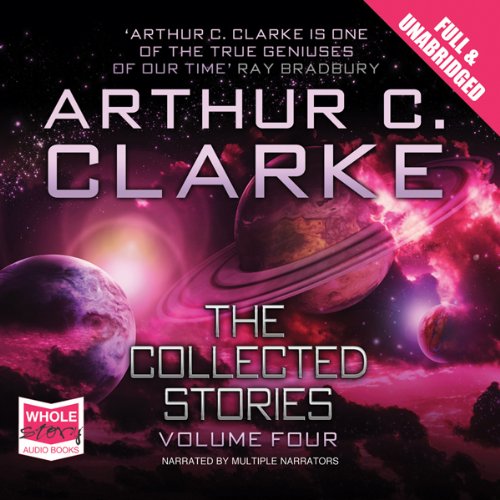
The Audible UK edition is narrated by Mike Grady, Ben Onwukwe, Nick Boulton, Roger May, and Sam Barrett, and runs to 10 hours and 24 minutes.
Discover more from Unfolded Universe: Sci-Fi Book Reviews
Subscribe to get the latest posts sent to your email.