
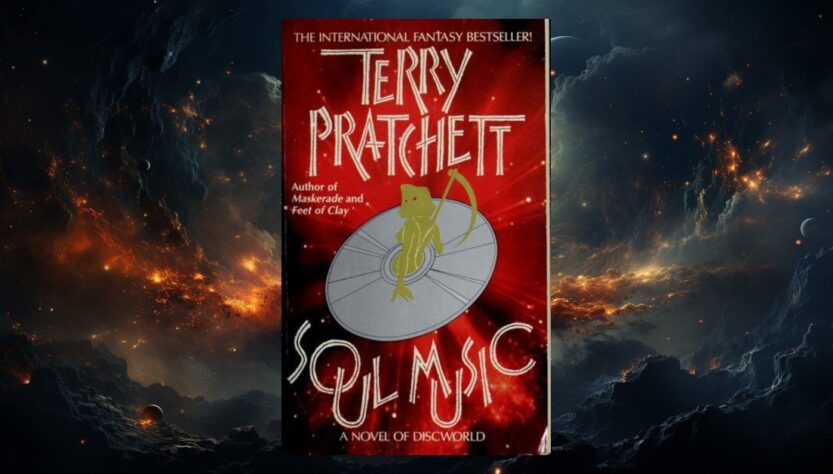
Review
Having read the whole Death run, Soul Music still feels like one of the most gleefully inventive turns Pratchett takes with that corner of Discworld. Mort introduces the idea that Death can carry a book; Reaper Man gives him real emotional weight. Soul Music takes that foundation and does something different again. It is less melancholy than Reaper Man, more chaotic, more satirical, and much more interested in the way culture can arrive like a thunderclap and leave everyone else trying to work out what just hit them.
The hook is glorious. Death goes missing, Susan Sto Helit gets dragged into family responsibilities she absolutely did not ask for, and Ankh-Morpork is suddenly infected by Music With Rocks In, a sound that is half rock and roll, half supernatural possession, and all bad news for anyone hoping for a quiet life. Pratchett gets a huge amount of comic mileage out of that setup, especially once Imp y Celyn and his increasingly famous band get caught up in something much bigger than ordinary fame. The jokes come thick and fast, but they are not random. This is one of those Discworld novels where the apparent silliness is doing a lot of real work underneath.
What makes the book land so well is that Pratchett clearly understands both the absurdity and the power of music culture. The riffs on rock mythology are everywhere, from the way names change and legends attach themselves to people overnight, to the dangerous glamour of performance, fandom, and reinvention. Even if you miss half the references, and there are plenty, the book still works because the feeling is right. Music here is not just a joke target. It is a force that changes identity, rewrites behaviour, and makes sensible people act like they have discovered religion in a back room with a drum kit.
Susan is a big reason the novel holds together. She has to carry a lot of the human side of the story, and Pratchett gets the tone just right with her. She is funny because she is so determined not to be funny, practical in a world that keeps presenting her with nonsense, and just prickly enough to stop the book turning sentimental. Watching her try to impose order on a situation that is fundamentally allergic to order gives Soul Music a lot of its spark. She is also a reminder that the Death books are often at their best when they are not really about Death alone, but about the poor souls stuck dealing with the consequences of his worldview.
I would not quite put Soul Music above Mort or Reaper Man in the Death sequence, even though Alex gave it five stars and I can see why. Mort is the cleaner character introduction, Reaper Man has the stronger emotional core, and later on Thief of Time probably has the bigger philosophical swing. What Soul Music has is a wonderful looseness that mostly works in its favour. It is messy in the way live music is messy, full of energy, half controlled, half possessed by its own momentum. A tidier version of the novel might actually have lost some of what makes it memorable.
That said, it is not flawless. The satire occasionally threatens to become a reference machine, and if you are not remotely interested in rock history or mythology you will probably get less out of some of the running gags. Pratchett also throws a lot into the mix, fame, adolescence, grief, inheritance, the seduction of cool, and not every thread bites equally hard. But even when the structure is a little baggy, the confidence of the voice carries it. By this point in Discworld, Pratchett knows exactly how to make a scene pivot from daft to poignant in a couple of lines.
What lifts it into five-star territory for me is the atmosphere. There is a fizz to Soul Music that feels different from the other mid-period Discworld books. It is funny, yes, but it is also haunted, in that very Pratchett way where the haunting is as likely to come from an idea as a ghost. Under the puns, the footnotes, and the gleeful nonsense, the novel is really about the stories people fall into when they want to become someone else. That gives it a surprising emotional aftertaste for a book with this many jokes about guitars, roads, hair, and trousers.
If your favourite Pratchett is the version that smuggles sharp observations about people into a story that looks utterly ridiculous from the outside, this is prime stuff. If you liked Good Omens for the way it treats pop culture and apocalypse with equal irreverence, or if the more character-driven Discworld books are your thing, Soul Music is an easy recommendation. It is funny, oddly wistful, and completely committed to the bit. More importantly, it earns that commitment.
Rating: 5/5
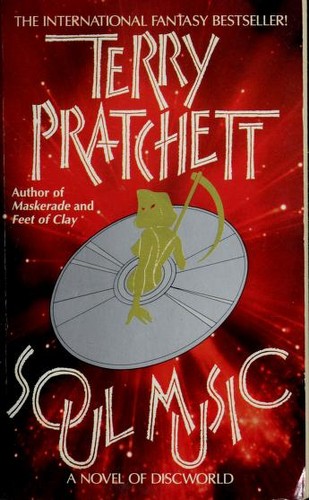
The Audible UK edition is narrated by Sian Clifford, Peter Serafinowicz, and Bill Nighy and runs to 11 hours and 22 minutes.
Discover more from Unfolded Universe: Sci-Fi Book Reviews
Subscribe to get the latest posts sent to your email.