
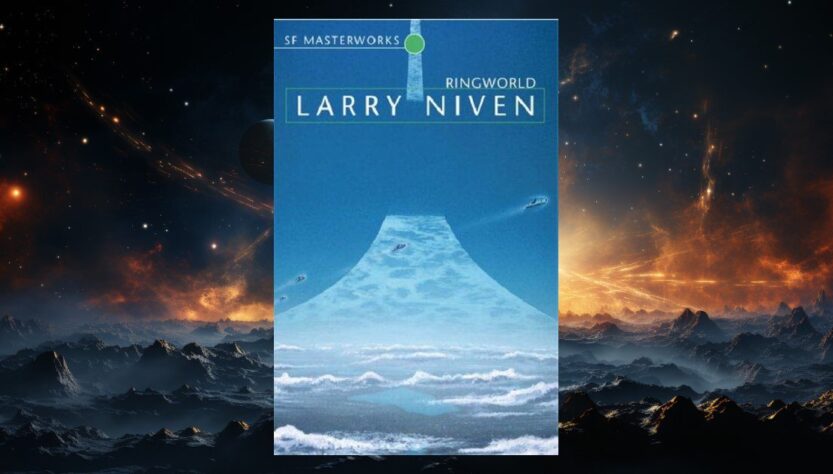
Larry Niven’s Ringworld is one of those science fiction novels that everybody tells you to read. It won both the Hugo and the Nebula in 1971. It inspired everything from Halo to the Culture series orbital habitats. The central concept, a massive artificial ring encircling a star with a habitable inner surface, is genuinely one of the most awe-inspiring ideas in the genre. And yet, after finally getting round to it, I’m left with the nagging feeling that the idea deserved a better book.
The Concept is Genuinely Spectacular
Let’s start with what works, because there’s plenty to admire here. The Ringworld itself is a staggering feat of imagination. Picture a ribbon of material 600 million miles in circumference, orbiting a sun, with walls a thousand miles high at the edges to keep the atmosphere in. The inner surface has an area roughly three million times that of Earth. Niven, an engineer at heart, clearly spent serious time working out the physics of this thing, from the shadow squares that simulate a day-night cycle to the way oceans and mountains are sculpted onto the inner surface. When the crew finally arrives and starts exploring, there’s a genuine sense of wonder at the scale of it all. This is hard sci-fi worldbuilding at its most ambitious.
The Known Space universe that Niven built around this story adds real texture too. The Pierson’s Puppeteers, those two-headed, three-legged aliens motivated entirely by cowardice and self-preservation, are a brilliantly original creation. The idea that their species is fleeing the galactic core because of an explosion that won’t reach Known Space for thousands of years tells you everything about their psychology in one detail. The Kzinti, the aggressive cat-like warriors who’ve lost multiple wars against humanity, provide a nice counterpoint. Niven clearly thought deeply about how different species would evolve different approaches to survival.
The Crew is an Odd Bunch
The premise that brings these species together is fun. Louis Wu, a 200-year-old human who’s bored with life, gets recruited by the Puppeteer Nessus for an expedition to investigate the Ringworld. Along for the ride are Speaker-to-Animals, a Kzin diplomat with barely contained aggression, and Teela Brown, a young woman whose entire qualification for the mission is that she’s been selectively bred for luck.
That last bit is actually one of the more interesting ideas in the book. The Puppeteers, it turns out, have been secretly manipulating human breeding for generations through Earth’s Birthright Lotteries. Teela is the product of several generations of winners, and Nessus believes her genetic luck might protect the expedition. It’s a fascinating concept that raises all sorts of questions about determinism and whether luck can even be a heritable trait. Niven plays with it throughout the story, and it leads to some genuinely thought-provoking moments.
Louis Wu himself is a decent enough protagonist. He’s competent, experienced, and occasionally wry. But he never quite comes alive on the page. For a man who’s lived two centuries and explored most of Known Space, he feels surprisingly flat. He reacts to things. He solves problems. He doesn’t really grab you.
Where It Falls Apart
And this is where honesty has to kick in. For a book with such a magnificent central idea, the actual reading experience is oddly disjointed. The pacing lurches from one set piece to another with strange jumps that leave you wondering if you’ve missed a chapter. Characters will be in one situation, and then suddenly they’re somewhere else entirely, with the transition either rushed or simply skipped. It gives the whole thing a jerky, uneven quality that keeps pulling you out of the story just when you’re getting invested.
The character work, particularly around Teela, hasn’t aged well either. The gender politics here are a product of their era, and to be blunt, that era wasn’t great. Teela is less a character than a plot device; her inner life is thin, her agency is even thinner, and the way she’s written would raise eyebrows in almost any contemporary context. Niven was imagining dazzling futures for his megastructures and alien species, but apparently couldn’t extend that same creativity to how women function in his stories. It’s a frustration that other reviewers have noted too, and it’s fair to name it.
The narrative also has a habit of explaining things at length and then forgetting to make those explanations feel exciting. There are sections that read more like engineering notes than storytelling. If you love hard sci-fi to the point where a lengthy discussion of stasis fields and angular momentum is its own reward, you’ll forgive this. If you’re here for the human drama, you may find yourself checking how many pages are left more than you’d like.
A Better Alternative for the Same Itch
Here’s the thing: if what you’re after is that sense of exploring an ancient, mysterious megastructure with a small crew and an atmosphere of creeping awe, Arthur C. Clarke’s Rendezvous with Rama scratches the same itch and does it better. The pacing is tighter, the central mystery feels more genuinely mysterious, and Clarke trusts the silence and the scale to do the work rather than filling every moment with exposition. If you haven’t read Rama, honestly start there.
That’s not to say Ringworld isn’t worth reading. It is, particularly if you care about the history of the genre. The ideas genuinely influenced science fiction for decades, and there’s something satisfying about finally seeing where so many other things came from. The Puppeteers alone are worth the price of admission. But go in knowing it’s a book where the concept outpaces the craft, and you’ll have a much better time than if you’re expecting a novel that delivers on all its promise.
Rating: 3/5
The Audible UK edition is narrated by Tom Parker and runs to 11 hours and 15 minutes.
Discover more from Unfolded Universe: Sci-Fi Book Reviews
Subscribe to get the latest posts sent to your email.