
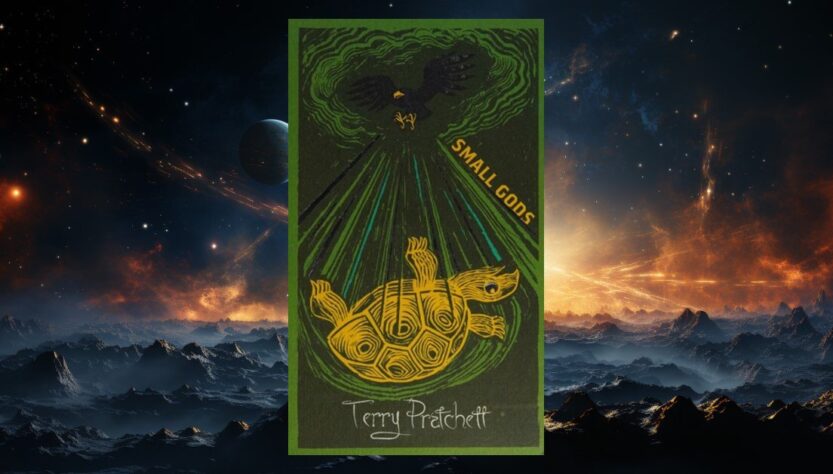
Coming after Witches Abroad by Terry Pratchett, Small Gods feels like Discworld stripping the stage bare and proving just how much weight Terry Pratchett can carry with ideas, character, and precision. This is still unmistakably one of the funny books, but the comedy is doing more than decorating the story. It is prising open questions about belief, institutions, cruelty, and conscience, then grinning at you while it does it.
The setup is brilliant. The great god Om turns up expecting thunder, awe, and instant obedience, only to discover he has manifested as a one-eyed tortoise and, worse, has only one true believer left. That believer is Brutha, a novice with a perfect memory, a guileless streak a mile wide, and far more steel in him than anyone around him realises. The relationship between those two carries the whole novel. Om is vain, bullying, needy, and frequently hilarious; Brutha looks simple to everyone else, but Pratchett makes his decency feel like a kind of intelligence that the powerful are too cynical to recognise.
What makes Small Gods stand out, even in a series this good, is how focused it is. A lot of early and middle Discworld novels are gloriously baggy, happily wandering off for a detour if there is a good joke at the end of it. This one is tighter. It still has the footnotes, the absurd bits of philosophy, and the dry throwaway lines that only Pratchett could land, but it is all in service of the same target. Omnia is not just a fantasy theocracy to laugh at. It is a machine built from ritual, fear, habit, and people convincing themselves that authority must be right because authority is powerful. Pratchett is not merely spoofing religion here, he is going after any institution that forgets what it was supposedly for.
That could have turned preachy in clumsier hands. Instead it becomes one of the most readable novels in the whole series because the ideas are embedded in character and motion. Brutha moving through a world full of priests, philosophers, tyrants, and opportunists gives Pratchett room for some superb contrast between genuine belief and performative certainty. There are scenes in Ephebe, and in the long arguments about gods, history, and truth, that feel much richer than a standard comic fantasy riff. If you like fantasy that can be silly and intellectually sharp at the same time, this is prime material.
Having read well beyond this point in Discworld, I think this is one of the books where Pratchett stops merely being a great comic fantasist and starts looking untouchable. Reaper Man had heart; Witches Abroad had bite; Small Gods has both, and it is more disciplined than either. It also helps that it is a genuine standalone. You do not need the City Watch, the witches, or Rincewind baggage for this one to work. If anything, the cleaner setting gives Pratchett more room to be direct. It is one of the easiest Discworld novels to hand to someone and say, here, this is why people become mildly evangelical about Terry Pratchett.
If I have a criticism, it is mostly about texture rather than substance. Because the book is so thematically locked in, it is slightly less generous with the sprawling, lived-in chaos that makes somewhere like Ankh-Morpork such a joy to revisit. Omnia is supposed to feel harsh, rigid, and airless, and it succeeds. That does mean the novel can feel drier than the warmest Discworld entries, even when it is being very funny. Whether that is a flaw or just part of the design probably depends on what you come to Pratchett for.
Still, this is top-tier Discworld for me. It is sharp without turning smug, humane without going soft, and very funny without ever losing sight of what it wants to say. If you liked Good Omens for the theological irreverence, or later Pratchett for the way he can hide serious moral arguments inside jokes and absurdity, Small Gods is about as good as that blend gets. It is a novel about gods, but really it is about what people choose to worship when power gets involved, and Pratchett is far too clever, and far too angry, to let anyone off lightly.
Rating: 5/5
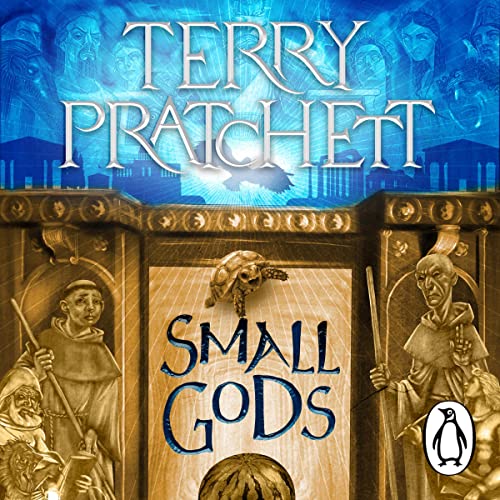
The Audible UK edition is narrated by Andy Serkis, with Bill Nighy and Peter Serafinowicz, and runs to 11 hours and 58 minutes.
Discover more from Unfolded Universe: Sci-Fi Book Reviews
Subscribe to get the latest posts sent to your email.